Gold has been one of the most traded instruments this year. And it’s also been one of the easiest markets to spot something that feels “off”.
A common 2025 situation looks like this:

You’re long or short Gold.
You check the chart, price moved in your favour.
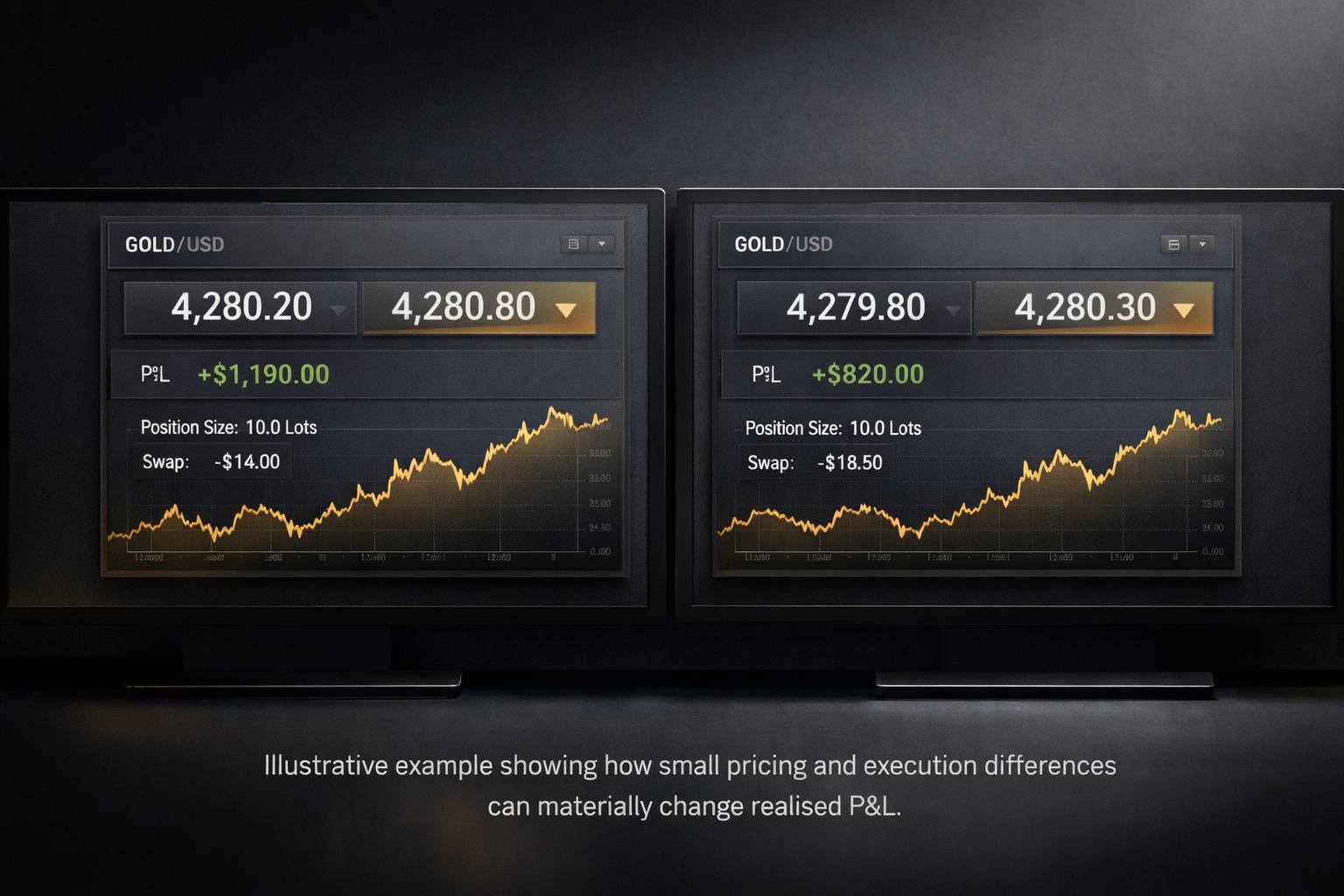
On one platform you’re up nicely.
On the other you’re barely up, or even down.
Same market. Same idea. Different P&L.
This post exists for one reason, to explain why that happens, and why, in 2025, some traders are making more than others without having a better strategy.
The difference is structure.
First, be honest: “Gold” is not one product
Most people think they trade Gold.
In reality they trade one of these:
- Gold CFD, synthetic pricing + financing rules set by the broker
- Gold futures, exchange-traded, expiry and roll mechanics
- Gold spot reference, quoted OTC, often used as a pricing input
- Gold ETFs, an investment product with its own tracking and costs
These can all move in the same direction and still produce different outcomes.
So when you say “same trade”, what you often mean is:
same market exposure, different contract.
And contracts don’t behave the same.
Why this shows up more in 2025
Gold has spent long periods at elevated prices in 2025, with sharp moves around:
- central bank expectations
- geopolitical headlines
- liquidity pockets where spreads widen and fills become messy
When markets are moving fast, platforms diverge more. Not because one is “rigged”, but because their mechanics are different.
In quiet conditions, you don’t notice it.
In 2025 conditions, you do.
The real reasons two platforms show different Gold P&L
1) Bid/ask and spread are the first leak
Gold is often quoted with noticeably different spreads across venues, especially in volatility.
If Platform A shows you a wider bid/ask than Platform B, your entry starts at a different cost base. Your floating P&L will diverge from minute one.
Most traders compare charts.
They should compare bid/ask at the moment they trade.
That’s where the P&L gap starts.
2) The price feed and reference price can be different
Two charts can look the same and still be using different pricing inputs.
Some platforms display a mid-price. Others display executable prices. Some platforms smooth or aggregate their price. Others print the raw feed.
Gold is a prime example where tiny differences in reference price become meaningful once size increases.
The result is simple:
same move, different P&L readout.
3) Financing, swaps, and holding time
Hold Gold overnight and the rules matter.
Different platforms apply financing differently, including:
- timing of charges
- rollover conventions
- holiday handling
- triple-day adjustments
In 2025, with funding costs still relevant, this can be the difference between “good trade” and “why is this not paying”.
This is where many traders get angry, because the market did what they expected, yet the P&L doesn’t reflect it.
4) Execution mechanics, especially in fast markets
Both platforms can say “market execution” and still fill you differently.
Under volatility:
- liquidity thins
- spreads widen
- slippage shows
- order handling rules matter
Gold is notorious for this around major headlines. If you’re trading size, fill quality and slippage tolerance can become the entire story.
Some traders make more in 2025 not because they pick direction better, but because their execution is cleaner.
5) Your “same trade” may not be the same size or tick value
Even experienced traders get caught here.
Contract specs can differ:
- lot size definitions
- minimum price movement
- tick value and P&L calculation method
- base currency conversion
Two accounts can show different P&L simply because you’re not comparing apples with apples.
So why do some traders make more than others in 2025?
Because they’re not bleeding performance through the structure.
They’ve got:
- tighter all-in costs for their style
- execution that behaves under stress
- financing that matches their holding period
- a contract spec that aligns with how they manage risk
In other words, the same directional idea can pay differently depending on where and how it’s traded.
That’s the uncomfortable truth.
The takeaway
When two platforms show different Gold P&L, the question isn’t which one is “right”.
It’s whether the structure matches what you’re doing.
If you’re:
- increasing size
- holding positions overnight
- trading around data and headlines
- scaling frequency
then execution, financing, and contract design become as important as entry and exit.
Most traders only look at this after frustration sets in.
The smarter move is earlier, when the numbers first stop lining up and you’re still in control.
Why this post exists
This isn’t a pitch for Gold, and it isn’t a pitch for a specific broker.
It’s a reality check.
In 2025, outcomes are increasingly shaped by:
pricing, execution, financing, and structure, not just “good calls”.
Market commentary only. Not investment advice.


 KyriWealth – Prime Access
You must be logged in to post a comment.